
Policies
Peer Review Process
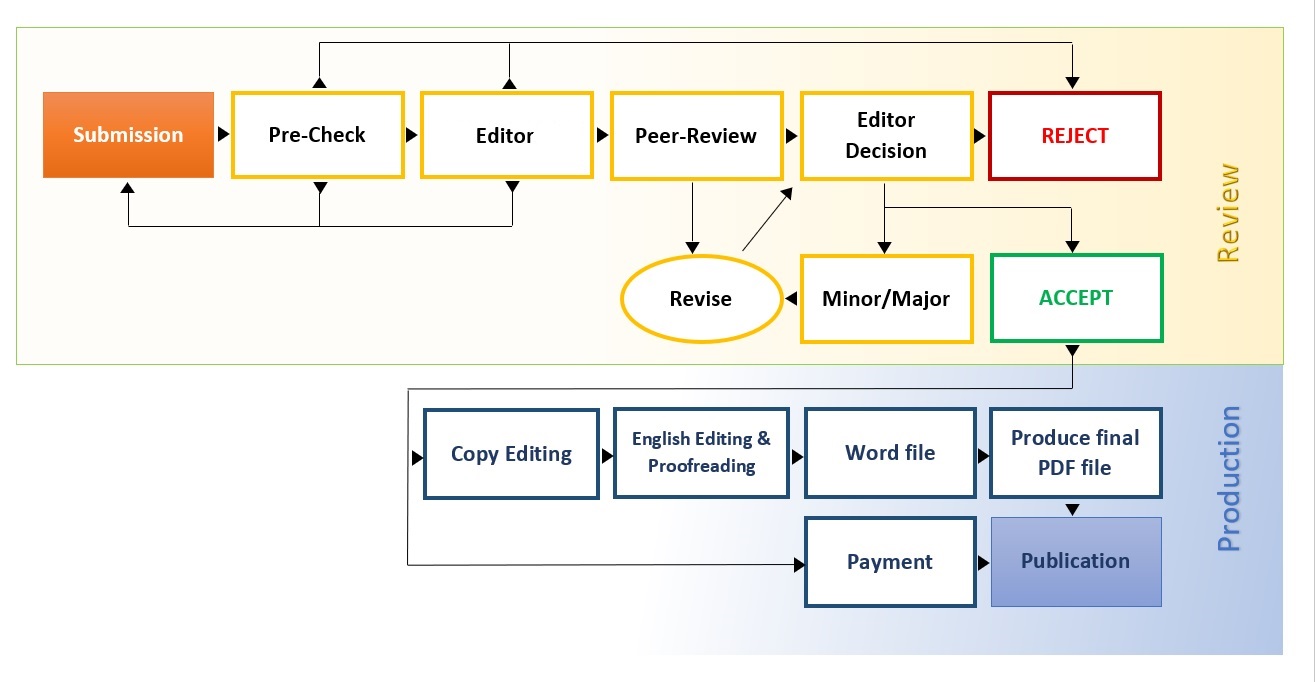
Engineering and Technology Journal (ETJ) uses a double-blind peer-review system to assure the quality of the publication. All manuscripts should be submitted through our online manuscript management system. The author should first register in our system and then submit their manuscript. ETJ depends mostly on international and national reviewers. Papers deemed suitable are then typically sent to a minimum of two independent expert reviewers to assess the scientific quality of the paper. The peer-review process mainly follows three steps, starting as the manuscript is submitted by the author to ETJ:
Step 1
As soon as the journal editorial office receives the manuscript, it will be checked and assessed by the journal editorial office and the editor. The initial desk assessment includes:
- Checking text similarity using Turnitin. Similarity reports are reviewed by the editorial office, and the similarity percentage alone is not used to determine plagiarism. A 20% similarity index is used as a screening threshold to flag submissions for closer assessment, considering the nature and source of overlap.
- Determining if the manuscript covers a suitable topic and fits the aims and scope of the journal.
- Ensuring the manuscript meets the basic requirements of the journal's guidelines and instructions for authors, such as word count, clarity of the English language, and format.
- Assessing if the submission makes a significant contribution to the existing literature.
- Checking for an abstract with suitable word count, affiliation details of the author, figures, tables, and their citation in the text.
- Verifying author's contributions, declaration of competing interest, funding, and data availability statement.
- Assessing commitment to high-quality research and ethical standards.
- Ensuring standards of reliability to qualify for further review.
If the submitted manuscript does not pass the initial checklist, the editor might reject the manuscript. If the manuscript does pass the initial checklist, it will transfer to the second step (i.e., peer review).
Step 2
The editor will select and contact at least two reviewers who are experts in the field of the manuscript and ask them to review the manuscript. The reviewers will be asked to advise the editor whether the manuscript is suitable for publication in ETJ according to the following observations:
- The manuscript fits the scope of ETJ.
- The novelty or originality of the study.
- The suitable description of the study design and methodology.
- Experimental and theoretical sections, results, and discussion are appropriately and clearly presented.
- The conclusions of the manuscript are trustworthy, significant, and supported by the research work.
Once the editor has received the reviewers' reports, the decision will be shared with the author along with any additional guidance. The final decision could be:
- Accept
- Minor revision
- Major revision
- Reject
- Others
The author(s) will often need to revise their manuscript and resubmit the revised version with a response to the reviewers’ comments, or the manuscript may be rejected.
Step 3
If the editor and reviewers have recommended a minor or major revision, the author can amend the manuscript based on the reviewers' comments. The author should then resubmit the revised manuscript with the response to reviewers’ comments as a separate file. Upon resubmission, the editor will review the revised version and send it for a second round of peer review, asking the reviewers to check the adequacy of the response.
Finally, if the revisions have brought the manuscript up to the requirement of ETJ, it will be transferred to production.
Authorship Guidelines
Engineering and Technology Journal follows the International Committee of Medical Journal Editors (ICMJE) guidelines. To qualify for authorship, authors must satisfy the following:
- Substantial contributions to conception or design of the work; or acquisition, analysis, or interpretation of data.
- Drafting the work or revising it critically for intellectual content.
- Final approval of the version to be published.
- Agreement to be accountable for all aspects of the work and accuracy of any part of the work.
Contributors not qualifying for authorship should be listed in the acknowledgments. Changes to the author list during or after publication require approval by all authors, including those removed. ETJ reserves the right to request evidence of authorship. Changes to authorship after acceptance are at the discretion of ETJ.
Criteria for Authorship
- Substantial intellectual contributions required for authorship (e.g., research question, design, analysis, interpretation).
- Technical services, translation, patient identification, material supply, funding or administrative oversight alone are not sufficient for authorship but may be acknowledged.
- One author (“guarantor”) should take responsibility for the integrity of the work as a whole.
- All authors should approve the final manuscript version and ideally be familiar with all aspects of the work.
- Team contributions may be limited to specific aspects for some authors.
Number of Authors
Editors should not arbitrarily limit the number of authors. For multi-center trials, a subset may be listed as preparing the manuscript on behalf of contributors. Corporate or group authorship is allowed if one investigator takes responsibility. All listed must meet criteria for authorship. If the number of authors is unusually large, editors may require a detailed description of contributions. Names of those not meeting the criteria may be removed.
Order of Authorship
Authors themselves decide the order of listing based on respective contributions and agreements. The meaning of the order should be described by the authors if relevant.
Authorship Disputes
Disputes are best settled locally before journal review. Editors may become involved at their discretion. Changes in authorship at any stage of review or acceptance should be accompanied by a written request and explanation from all original authors.
User License Agreement
ETJ provides access to archived material through ETJ archives. All open access articles are free to read and download. Permitted reuse is defined by the Creative Commons Attribution 4.0 International (CC BY 4.0).
Deceased Authors
If a manuscript includes a deceased author or one passes during review, inform the editorial office. If the corresponding author is deceased, the group should nominate a replacement. The contribution and conflicts of the deceased author must be confirmed. Upon publication, a note will be added under the author list.
Conflict of Interest
Authors must clearly state conflicts of interest and upload the conflict of interest form during submission. A clear statement should be included in the manuscript.
Responsibilities on Conflicts of Interest
Public trust and published article credibility depend on handling conflicts of interest transparently. Financial relationships (employment, consultancies, stock, honoraria, patents, expert testimony) are most identifiable and may undermine credibility. Other conflicts may arise from personal relationships, competition, or beliefs. All participants in publication—authors, reviewers, editors, editorial board—must consider and disclose any potential conflicts.
Authors
Authors must disclose all financial and personal relationships that could bias their work.
Reviewers
Reviewers are asked about conflicts when assigned a manuscript. They must disclose any conflicts to editors, recuse themselves if bias may exist, and must not use knowledge of the manuscript to further their interests.
Editors
Editors who make final decisions on manuscripts should recuse themselves from decisions if conflicts or potential conflicts exist. Other editorial staff must provide a description of their financial interests or conflicts and recuse themselves as appropriate.
Reporting Conflicts of Interest
- Articles should publish statements or supporting documents declaring:
- Authors’ conflicts of interest
- Sources of support for the work, including sponsor names and the role of sponsors in study design, data collection, analysis, interpretation, writing, and decision to publish (or a statement that the source had no involvement)
- Access to study data, with explanation of nature and extent of access
- Editors may require authors of funded studies to sign a statement confirming full data access and responsibility for integrity and accuracy.
Appeals and Complaints
Readers who have concerns or complaints about published papers may contact the Editorial Office directly. Where appropriate (e.g., minor factual corrections), readers may also contact the corresponding author; however, this is not required.
The Editorial Office will coordinate with the complainant, author(s), the Editor-in-Chief, and/or Editorial Board members as needed for the investigation, remedy, or resolution of concerns or complaints, in accordance with the journal’s procedures and COPE guidance.
Complaints, comments, or update requests relating to scholarly validity, ethical or legal aspects of either the paper or its review process will be investigated further where appropriate. All complaints, comments, or update requests relating to published papers are investigated by the Editorial Office with the support of the Editorial Board and final approval by the Editor-in-Chief. For ethical concerns, final decisions are made by the Editor-in-Chief or Editorial Board members, who are supported by the Editorial Office to promote adherence to core principles of publication ethics as expressed by the Committee on Publication Ethics (COPE). Other persons and institutions may be consulted as necessary, including university authorities or experts in the field. Legal counsel may be sought where the complaint has legal implications.
Personal comments or criticisms will not be entertained. All complaints are investigated, including anonymous complaints. Complainants may request that the Editorial Office handle their complaint confidentially, and the Editorial Office, Editors-in-Chief, or other Editorial Board members will attempt to do so as appropriate and in accordance with our procedures.
Decisions about Corrections, Comments and Replies, Expressions of Concerns, or Retractions resulting from an investigation are made by Editors-in-Chief or Editorial Board members and communicated to authors.
If a complaint is not considered substantiated, further communication will only be considered if additional information evidencing concerns is presented.
Complainants might not be updated about the status of an investigation until a final decision has been reached; however, complainants will be notified if an update is published. The Editorial Office and Editorial Board members are under no obligation to present further detail. Communication will be ended where it is not considered cordial or respectful. Readers with complaints or concerns should be aware that investigations take time to conduct.
How to Raise Concerns
When raising concerns to the Editorial Office, please contact us at etj@uotechnology.edu.iq. Details about the paper should be included in the complaint email. Also, include details of the complaint, its scholarly, scientific or academic validity, a summary of the main points and any other issues, details of any correspondence already had with the authors, and a statement clarifying any actual, potential, or perceived conflicts of interest.
Allegations of Misconduct
ETJ is very sensitive to research misconduct and uses all means available to prevent publishing research misconduct. The Council of Editors defines research misconduct broadly in three categories of action and conducts. ETJ uses this definition of misconduct in dealing with the issue and strictly follows the COPE charts in dealing with research misconduct.
In addition, for each component of the research misconduct, ETJ has many assurance policies as follows:
- Mistreatment of research subjects
- Falsification and Fabrication of data
- Piracy and Plagiarism
Protection of Animal rights
ETJ does not publish manuscripts that do not declare a statement about the protection of animal rights. Normally, the journal requires that a statement is declared that research has been reviewed by an institutional review board either in the material method section of the manuscript or in the acknowledgment section of the manuscript. In addition, ETJ encourages authors to report the registry number of the council certification.
Falsification and Fabrication of data
Fabrication is defined as making up data without actually collecting or synthesizing scientific data. Falsification is defined as manipulating research material to reach a favorable result. Fabrication and falsification could happen at any research stage (in the field) up to the publication of a manuscript where citation can be misused (referencing a citation when the citation does not support the argument). ETJ tries to identify any kind of fabrication or falsification in all levels of manuscript processing, from initial screening to comprehensive evaluation of a revised manuscript and even after a manuscript has been published.
Reporting any fabrication and falsification is an ethical duty of our authors, co-authors, reviewers, editors, and readers. In any event of falsification or fabrication, ETJ keeps its right to retract or withdraw the fabricated or falsified article. ETJ strictly follows the COPE charts in dealing with fabrication and falsification.
Plagiarism
Plagiarism is the appropriation of another person's ideas, processes, results, or words without giving appropriate credit. Another category of plagiarism is self-plagiarism, when the author published his own idea, data, and text in different journals when no need for such duplication exists. ETJ uses all means to detect plagiarism. As a matter of quality assurance, manuscripts with a similarity index above 20% are flagged for closer editorial assessment; decisions consider the nature and source of overlap. ETJ strictly follows the COPE charts in dealing with plagiarized articles.
Plagiarism Policy
Plagiarism is not acceptable in Engineering and Technology Journal (ETJ) because plagiarism is a serious violation of publication ethics. Plagiarism includes copying text, tables, images, or data from another source, even from the author's own publications, without crediting the original source.
All manuscripts submitted to ETJ are checked for plagiarism using standard software Turnitin. This software checks content against a database of periodicals, the internet, and a comprehensive article database. It generates a similarity report, highlighting the percentage overlap between the submitted manuscript and the published document.
If overlap is assessed as legitimate (e.g., references, methods, quotations), the manuscript may proceed to peer review. ETJ applies a 20% similarity index as a screening threshold; manuscripts at or above this threshold are flagged for closer editorial assessment. Similarity below 20% does not by itself confirm originality, and all similarity reports are subject to editorial review. Where inappropriate overlap or suspected plagiarism is identified, the manuscript may be rejected and handled in line with COPE guidance. If plagiarism is detected after publication, the manuscript is retracted from the journal website after careful investigation and approval by the journal's Editor-in-Chief.
Engineering and Technology Journal severely follows the committee of publication ethics (COPE) guidelines to detect plagiarism; for more clear insight, authors may refer to flowcharts provided by COPE by clicking here or visiting the COPE website.
Revenue Sourcing
Engineering and Technology Journal (ETJ) is a self-financing journal and does not receive funding from any source, except for staff salaries, which are paid by the publisher (University of Technology-Iraq). Publication costs are covered solely by the Article Processing Charges (APCs) paid by authors. As the journal is open access, there are no subscription charges. Payment of APCs or waiver status does not influence editorial decisions; all decisions are based solely on editorial assessment and peer review. The content is freely accessible to readers on the journal website. The journal does not accept advertisements.
Copyright Policies and Malpractice Statement
Engineering and Technology Journal is licensed under the Creative Commons Attribution 4.0 International License, which allows users to copy, create extracts, abstracts, and new works from the article, alter and revise the article, and make commercial use of the article (including reuse and/or resale of the article by commercial entities), provided the user gives appropriate credit (with a link to the formal publication through the relevant DOI), provides a link to the license, indicates if changes were made. The licensor is not represented as endorsing the use made of the work. The authors hold the copyright for their published work on the ETJ website. At the same time, ETJ is responsible for appreciating citation for their work, released under CC-BY-4.0, enabling the unrestricted use, distribution, and reproduction of an article in any medium, provided that the original work is properly cited.
Creative Commons Attribution
Creative Commons Attribution permits others to distribute and copy the manuscript, create extracts, abstracts, and other revised versions, adaptations, or derivative works of or from the manuscript (such as a translation), to include in a collective work, to text or data mine the article, even commercially, as long as they credit the author(s), do not represent the author as endorsing their adaptation of the article, and do not modify the article in such a way as to damage the author's honor or reputation. Further details are found at Creative Commons Attribution 4.0 International (CC BY 4.0)
Author Self-Archiving Policy
This policy sets out how the Engineering and Technology Journal (ETJ) authors can archive copies of their work on their own web pages, corporate web pages, and various other subject repositories.
ETJ is an open-access journal. Therefore, articles can be made available immediately according to their specific Creative Common license terms. If an author has published an article under an Open Access license, ETJ would encourage the author to share the Version of Record on publication as opposed to the Accepted Manuscript.
Authors may also reuse the Abstract and Citation information (e.g., Title, Author name, Publication dates) of their article anywhere at any time including social media such as LinkedIn, Facebook, blogs and Twitter, providing that where possible a link is included back to the article on the ETJ site. Preferably the link should be, or include, the Digital Object Identifier (DOI) which can be found in the Citation information about the article online. In addition, the author may place the accepted version in the author personal website and/or the author company/institutional repository or archive. Self-archiving of the submitted version is not subject to an embargo period.
A summary is provided as follows:
Preprints
Authors can share their preprint anywhere at any time. If accepted for publication, we advise authors to link the preprint to their formal publication via its Digital Object Identifier (DOI).
Author Accepted Manuscripts
Authors are free to share (Author Accepted Manuscript) on any institutional or subject repository.
Published articles (Version of Record)
All authors and users are free to use, reproduce, or distribute the works published in ETJ in any way they prefer on the condition that the reproduced/redistributed material acknowledges that it was originally published in ETJ with all relevant publication details. When sharing works published originally in ETJ on other platforms, we advise using the final version made publicly available on ETJ website.
ETJ is now formally archived at the Iraqi Academic Scientific Journal (IASJ)
Crossmark Policy
Crossmark is an initiative that provides a standard way for readers to locate the current version of a piece of content and to see whether any updates (e.g., corrections or retractions) have been issued.
Where a Crossmark button is displayed on an ETJ article, clicking it will show the current status of the document and may provide additional publication record information.
Crossmark is not currently applied to articles published after [Volume 43__ / Issue _12_ / Year _2025_] due to technical and workflow changes following the journal’s migration to a new publishing system. ETJ is evaluating options for future use of Crossmark and will update this policy if and when implementation changes.
Correction and retraction of articles
Modifications to a published article can be implemented under the approval of the journal's editor. The extent of these modifications will be determined by the editors, with minor corrections being directly applied to the initial article. In instances of significant corrections, the original article will remain unaltered, and the rectified version will be separately published. A linkage between the original and corrected versions will be established. A statement elucidating the rationale behind substantial alterations to the article will accompany the publication. If deemed necessary, article retractions will adhere to the guidelines outlined by COPE retraction guidelines.
Further reading: COPE Guidelines COPE FlowchartsData Sharing & Reproducibility Policy
Engineering and Technology Journal (ETJ) supports transparency and reproducibility in scholarly research and encourages authors to make the data and/or code underlying their findings available whenever feasible and appropriate.
Data Availability Statement
ETJ expects manuscripts to include a Data Availability Statement indicating the availability of the data and/or code supporting the findings.
Options for data/code availability
Authors may indicate one of the following in the Data Availability Statement:
- Publicly available: data/code are available via a repository or supplementary materials (include a link and/or identifier where applicable).
- Available on request: data/code are available on request from the corresponding author.
- Not available: data/code are not available.
Reproducibility information
Regardless of data sharing arrangements, authors should provide sufficient methodological detail to allow readers to understand and verify the work, including relevant tools/software (and versions), key parameters, and analysis steps where applicable.
Editorial checks
ETJ may request clarification of the Data Availability Statement or supporting materials during editorial assessment when needed to evaluate the manuscript.
Generative Artificial Intelligence (AI) Policy
Engineering and Technology Journal (ETJ)
Introduction
This policy provides guidance on the responsible and transparent use of generative artificial intelligence (GenAI) and AI-assisted technologies in the publication process of the Engineering and Technology Journal (ETJ). The policy applies to authors, reviewers, and editors and aims to preserve the integrity, originality, and reliability of scholarly publications.
Generative AI technologies are increasingly used in academic writing and research workflows. While such tools may support language improvement and productivity, they must not replace human intellectual contribution, scientific judgment, or ethical responsibility.
These guidelines will be periodically reviewed and updated to reflect advances in technology, publishing standards, and ethical considerations.
Policy for Authors
1. Use of AI in Manuscript Preparation
This policy addresses the use of generative AI tools in manuscript preparation and the publication process.
Authors may use AI-assisted technologies to improve grammar, spelling, readability, and language clarity. However, such use must always involve human oversight, and authors must carefully review and revise any AI-generated output to ensure accuracy and scientific integrity.
Generative AI tools must not be used to generate substantial scientific content, such as research arguments, interpretations, conclusions, or scholarly insights that should originate from the authors.
The authors retain full responsibility for all content in the submitted manuscript, including any material produced with the assistance of AI tools.
Basic spelling or grammar correction tools that do not generate substantive content do not require disclosure.
2. Disclosure of AI Use
To ensure transparency, authors must disclose any material use of generative AI or AI-assisted tools that contributed to the manuscript text or content.
The disclosure should include:
- The name of the tool used
- The version (if available)
- The purpose of use
- The extent of the use
The disclosure should be included in the Acknowledgment section or a dedicated statement within the manuscript.
Suggested disclosure statement:
“During the preparation of this manuscript, the authors used [TOOL NAME] for [PURPOSE]. The authors reviewed and edited the generated content and take full responsibility for the final content of the manuscript.”
Failure to disclose material use of generative AI tools may be considered a breach of publication ethics.
3. AI in Research Methods
The use of AI technologies as part of the research methodology (e.g., machine learning models, AI-based simulations, data analysis tools, image analysis, or predictive models) is permitted and often appropriate in engineering and technology research.
When AI tools are used in the research process, authors must describe them transparently in the Methods section, including:
- Tool or model name
- Version or framework used
- Parameters or configuration
- Training data (if applicable)
- Implementation details necessary for reproducibility
Such use must be scientifically justified and clearly distinguishable from AI used for writing assistance.
Author Responsibility and Verification
Authors remain fully responsible for verifying all content within the manuscript, including any content generated or assisted by AI tools.
Authors must ensure:
- The accuracy and validity of all statements and scientific claims
- That all cited references are real, appropriate, and correctly represented
- That AI-generated content does not introduce fabricated references or incorrect information
- That confidential data, unpublished material, or copyrighted third-party content is not entered into AI tools without proper authorization
Authors are also responsible for ensuring that the manuscript:
- Is original work
- Does not breach third-party rights
- Complies with the journal’s ethical publishing guidelines
AI and Authorship
Generative AI tools cannot be listed as authors or co-authors of a manuscript.
Authorship is restricted to individuals who meet established authorship criteria, including:
- Significant intellectual contribution
- Responsibility for the integrity of the work
- Ability to verify and defend the research findings
AI tools may be acknowledged if their use was significant and disclosed appropriately.
Use of AI in Images, Figures, and Artwork
The use of generative AI tools to create, manipulate, or alter images, figures, or visual data in a way that misrepresents research findings is not permitted.
This includes:
- Fabricating scientific images
- Altering experimental results
- Adding, removing, or modifying visual elements that affect interpretation
Basic adjustments such as brightness, contrast, or color balance are allowed only if they do not alter the scientific meaning or interpretation of the data.
If AI tools are integral to the research methodology (for example, in medical imaging, computer vision, or image classification), their use must be clearly described in the Methods section, including the tool name, version, and relevant parameters.
The journal may request original, unedited image files for verification during the editorial process.
The use of generative AI to create graphical abstracts or cover artwork is not permitted unless prior written approval is obtained from the editorial board and all necessary rights are secured.
Policy for Reviewers
Use of AI During Peer Review
Peer review requires confidentiality, independent scholarly judgment, and ethical responsibility.
Reviewers must treat all submitted manuscripts as strictly confidential documents.
Reviewers must not upload, submit, or share any part of a manuscript with public AI tools or generative AI systems for analysis, summarization, or language editing, as doing so may compromise:
- Author confidentiality
- Intellectual property rights
- Data protection obligations
Reviewers must also not use generative AI tools to produce the substantive evaluation of a manuscript, including recommendations or critical analysis.
The review report must reflect the reviewer’s own independent assessment.
Reviewers remain fully responsible for the accuracy, fairness, and integrity of their evaluations.
The journal may internally use secure and approved AI-assisted tools for tasks such as plagiarism detection or reviewer identification, provided they comply with data protection and confidentiality standards.
Policy for Editors
Editorial Use of AI
Editors must also treat all submitted manuscripts, reviewer reports, and editorial communications as confidential information.
Editors must not upload or process manuscript content using public generative AI tools, as this may compromise confidentiality and intellectual property protections.
Editorial decisions—including manuscript evaluation, reviewer selection, and communication of editorial decisions—must be made by human editors.
Generative AI tools must not be used to replace editorial judgment or generate editorial decisions.
The journal may use secure, licensed, or in-house AI technologies to assist in editorial workflows, including:
- plagiarism detection
- similarity checks
- reviewer suggestions
- administrative screening tasks
All such tools must comply with data protection regulations and ethical publishing standards.
If editors identify potential misuse of AI by authors or reviewers, the matter should be reported to the Editor-in-Chief for further investigation.
Final Statement
The Engineering and Technology Journal encourages the responsible, ethical, and transparent use of artificial intelligence technologies in scientific research and communication.
All authors, reviewers, and editors are expected to strictly adhere to this policy to maintain the integrity, credibility, and scholarly quality of the journal.